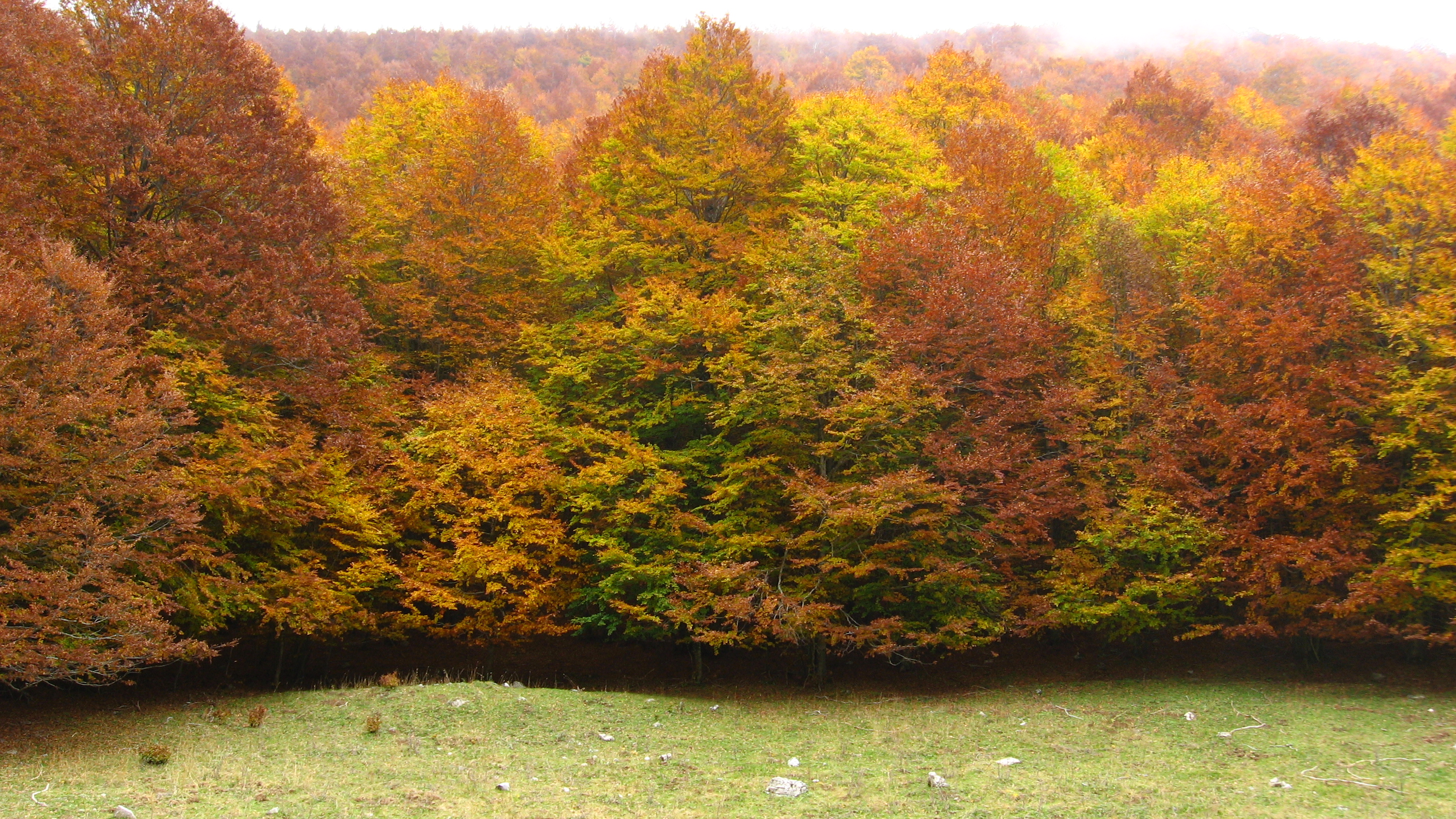
Gran Sasso e Monti della Laga National Park, Abruzzo. Photo: Wikimedia Commons / CC BY-SA
Geography and extent
Gran Sasso e Monti della Laga National Park was established in 1991 and covers approximately 150,000 hectares across three Italian regions: Abruzzo, Lazio, and Marche. It is the largest protected area in the central Apennines and one of the most ecologically diverse in all of Italy.
The park is divided into two distinct massifs. The Gran Sasso d'Italia range rises to Corno Grande at 2,912 metres — the highest point in the Apennines south of the Alps. The Monti della Laga range to the northwest, peaking at Monte Gorzano (2,458 m), is characterised by sandstone geology and dense beech forests fed by exceptionally high precipitation.
Between these two massifs lies the Campo Imperatore plain, a high plateau at approximately 1,800 metres. Formed by glacial processes during the Quaternary period, it functions today as an open, semi-arid grassland with flora typical of central Eurasian steppes — an unusual environment for the Italian peninsula.
The Calderone Glacier
On the northeastern face of Corno Grande sits the Calderone Glacier, the southernmost glacier in Europe and the only one on the Apennine chain. Its surface area has decreased sharply over the twentieth century: from roughly 6 hectares in 1990 to approximately 3 hectares by 2020, according to measurements by the Italian Glaciological Committee.
The glacier is technically now classified as a glacieret — a remnant ice body too small to exhibit the internal flow dynamics of a true glacier. What remains is maintained in part by wind-blown snow accumulating in the shaded cirque and by the protection of the north-facing aspect below Corno Grande's summit. Its eventual disappearance is considered likely within the coming decades under current temperature projections.
Altitude zones and plant communities
The park encompasses five altitude belts, each supporting characteristic vegetation assemblages:
- Submontane belt (below 900 m): Downy oak (Quercus pubescens) and hop hornbeam (Ostrya carpinifolia) woodland, transitioning to maquis on south-facing slopes.
- Montane belt (900–1,600 m): European beech (Fagus sylvatica) forests dominate, with old-growth stands in the more remote valleys. Silver fir (Abies alba) appears in mixed stands on the Laga side.
- Subalpine belt (1,600–2,000 m): Beech becomes stunted and krummholz-like near its upper limit. Dwarf mountain pine (Pinus mugo) and Juniperus communis nana shrubs take over.
- Alpine belt (2,000–2,600 m): Open grasslands dominated by Sesleria and Festuca grasses, with numerous cushion-forming and geophyte species. Several plants are endemic to the Gran Sasso massif.
- Nival belt (above 2,600 m): Sparse pioneer vegetation in rock crevices, snowfields, and the glacial cirque around Corno Grande.

Gran Sasso e Monti della Laga, May 2017. Photo: Wikimedia Commons / CC BY 2.0
Endemic and rare flora
The botanical richness of Gran Sasso is substantial. Over 2,400 vascular plant species have been recorded within the park boundaries — roughly a quarter of the entire Italian flora. Among these, several taxa are endemic to the Gran Sasso massif or the central Apennines:
- Adonis distorta — a buttercup-family species restricted to the Gran Sasso alpine grasslands
- Leontopodium nivale subsp. apenninum — the Apennine edelweiss, morphologically distinct from the Alpine form
- Papaver alpinum subsp. ernesti-mayeri — a poppy endemic to rocky Gran Sasso slopes
- Viola eugeniae — a violet species known only from the Apennine alpine belt
The Campo Imperatore plateau supports a separately notable community of steppe species, including Astragalus sempervirens and various Astragalus cushion plants unusual in an Italian context.
Fauna: the Marsican brown bear and beyond
While the Marsican brown bear (Ursus arctos marsicanus) is primarily associated with the Abruzzo, Lazio and Molise National Park to the south, individuals regularly cross into Gran Sasso territory. The estimated population of 60–70 bears within the central Apennine protected area complex moves between the two parks along forested ridge corridors.
The Italian wolf (Canis lupus italicus) is well established throughout the park, with multiple documented packs using the beech forest zones and mountain grasslands. Camera trap surveys conducted by the park authority have confirmed breeding activity in several valleys.
Other notable species include:
- Apennine chamois (Rupicapra pyrenaica ornata) — reintroduced to Gran Sasso from the Abruzzo park in 1990s; population now self-sustaining
- Apennine hare (Lepus corsicanus) — endemic lagomorph, present in mountain grasslands
- Golden eagle (Aquila chrysaetos) — resident breeding pairs in cliff zones
- Peregrine falcon (Falco peregrinus) — nests on rockfaces throughout the massif
- Apennine yellow-bellied toad (Bombina pachypus) — endemic amphibian of highland pools
Hiking and access
The park is well served by a network of marked trails maintained by the Club Alpino Italiano (CAI) and the park authority. The Campo Imperatore plateau is accessible by road via the Gran Sasso tunnel from L'Aquila or by cable car from Fonte Cerreto. The summit of Corno Grande is reached via several routes, the standard ascent taking between four and six hours round trip from the plateau level.
The historic towns of L'Aquila, Teramo, and Ascoli Piceno serve as base points for access to the park's western, northern, and eastern sectors respectively. Within the park, several villages — including Santo Stefano di Sessanio, Castel del Monte, and Pietracamela — retain traditional Apennine architecture and serve as starting points for lower-altitude itineraries through beech and oak woodland.
Protection status and governance
Gran Sasso e Monti della Laga holds national park status under Italian Law 394/1991 and is also designated a UNESCO Man and Biosphere Reserve. Large portions of the park overlap with Natura 2000 sites under the EU Habitats Directive (92/43/EEC) and Birds Directive (2009/147/EC).
Management is overseen by the Ente Parco Nazionale Gran Sasso e Monti della Laga, based in L'Aquila. The park administration maintains visitor centres at Assergi, Pietracamela, and Isola del Gran Sasso. The official website is maintained at gransassolagapark.it.