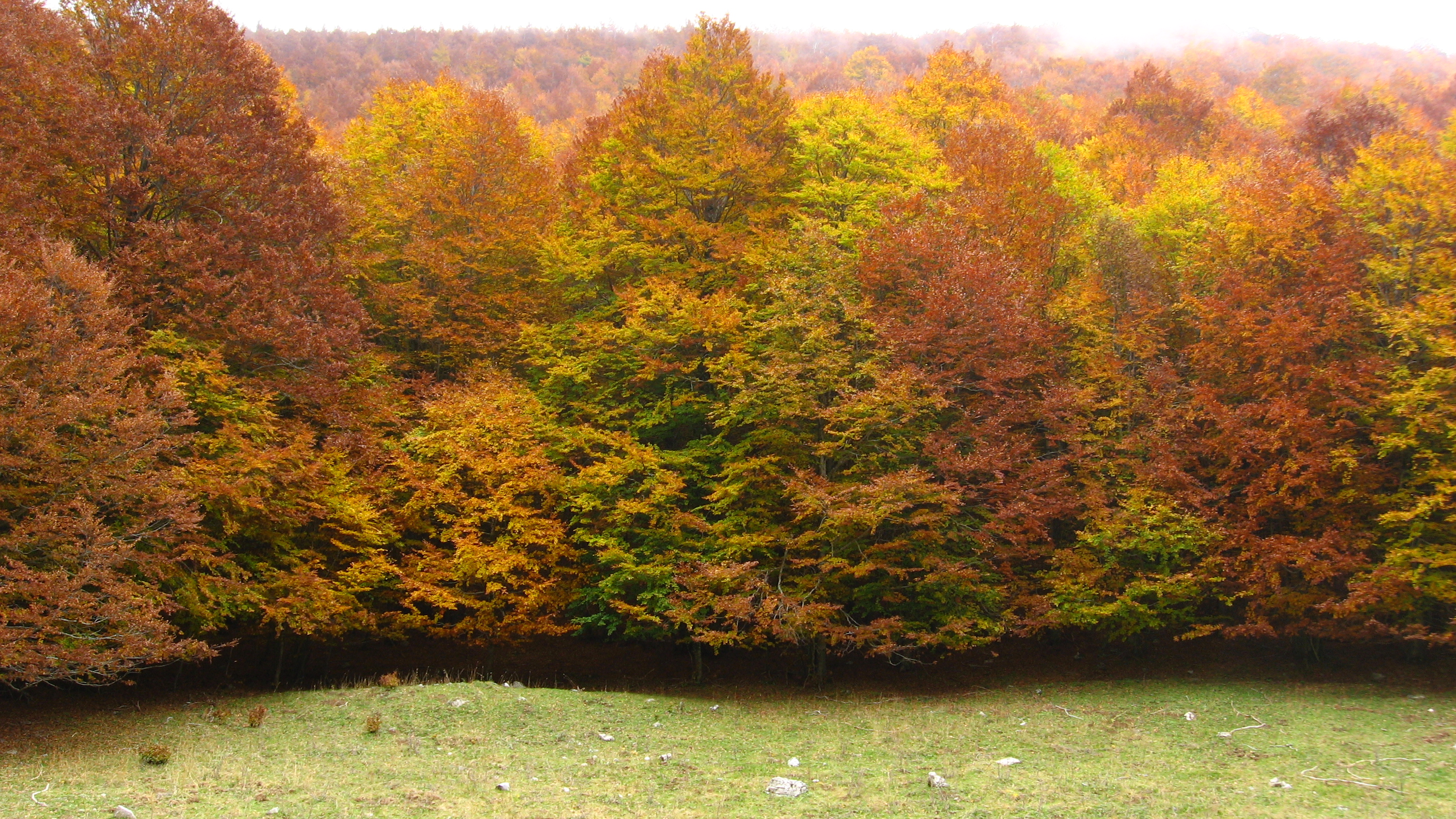
Beech forest (Fagus sylvatica) on the Pollino massif, southern Italy. Photo: Wikimedia Commons / CC BY-SA
Overview: the park and its position
Pollino National Park was established in 1988 and formally expanded to its current extent in 1993. At approximately 192,000 hectares, it is the largest national park in Italy, straddling the border between Basilicata and Calabria in the toe of the peninsula. The park is named for Monte Pollino (2,248 m), the highest peak in the southern Apennines south of the Sila plateau.
The southern Apennines at this latitude mark a biogeographic transition zone: the Mediterranean flora of the coastal lowlands meets the Eurasian montane and subalpine flora at the higher elevations, producing an overlap of species from two distinct floristic provinces. The result is a plant diversity unusual for its geographical position.
The park encompasses a range of distinct landscapes: the high ridge system of Monte Pollino and Serra Dolcedorme (2,267 m, the highest point in the park), lower beech-covered ranges, deep river gorges cut by the Lao and Mercure rivers, and the Mercure basin — a flat Quaternary sediment fill that is geologically anomalous in an otherwise rugged landscape.
The Bosnian pine: a relict of past climates
The most iconic tree species of the Pollino massif is the Bosnian pine (Pinus leucodermis, also known as Pinus heldreichii), which grows on the rocky limestone ridges above 1,700 metres. This species is adapted to extreme conditions: shallow soils, severe wind exposure, heavy winter snow loads, and wide temperature fluctuations between seasons.
The Pollino population of Bosnian pine is a relict — a remnant of a much wider distribution that existed during cooler periods of the Quaternary. As climates warmed after the last glaciation, the species retreated to higher elevations and fragmented into isolated populations across the Balkans and the southern Apennines. The Italian populations at Pollino and on the nearby Orsomarso mountains are the westernmost natural occurrences of the species.
Several individual trees on the Pollino ridges have been confirmed as being more than 1,000 years old through dendrochronological analysis. The oldest known specimen, informally named "Il Patriarca" and located at around 2,100 m on the Serra delle Ciavole, is estimated to be approximately 1,200 years old, making it one of the oldest living trees in Italy.
The Bosnian pine's tolerance for exposed limestone gives it a distinctive growth form on the high ridges: contorted trunks and branches shaped over centuries by prevailing winds, with bark bleached white on the dead wood. This architecture has made the ridge populations a subject of considerable photographic and scientific attention.
Beech forests and their dependent communities
Below the Bosnian pine zone, European beech (Fagus sylvatica) dominates from roughly 1,000 to 1,800 metres. The old-growth beech stands of Pollino, particularly in the valleys of the Raganello and Lao rivers, include trees of considerable age and structural complexity — multi-layered canopies with standing dead wood and fallen logs that support rich communities of wood-decay fungi, insects, and cavity-nesting birds.
The Raganello canyon, on the eastern flank of the park near Civita, is one of the most dramatic geomorphological features of the southern Apennines: a gorge up to 700 metres deep cut through limestone, with near-vertical walls supporting a vertical plant community from riparian vegetation at the base through mixed woodland to exposed rocky grassland at the rim. The canyon is also notable for its population of the Egyptian vulture (Neophron percnopterus), now a very rare breeder in Italy.
Endemic and rare flora
The botanical documentation of Pollino records over 1,800 vascular plant species within the park, including a significant number of endemic or near-endemic taxa:
- Centaurea kartschiana — a knapweed endemic to the Pollino limestone grasslands
- Rhinanthus personii — an endemic yellow rattle of the high meadows
- Fritillaria messanensis — a fritillary with a restricted distribution in the southern Apennines and Sicily
- Crocus polliniensis — a crocus described from Pollino, flowering in early spring through snow
- Several Ophrys and Orchis species whose southern Apennine distributions are centred on Pollino: Ophrys bertolonii, Orchis provincialis, and Dactylorhiza sambucina among them
The orchid flora of Pollino is particularly notable. The park contains over 50 documented orchid species, representing more than half of the entire Italian orchid flora in a single protected area. The combination of calcareous soils, altitude gradients, and the Mediterranean-continental climate transition creates the conditions for this concentration.
Reptile diversity: a southern Apennine characteristic
The southern Apennines as a whole, and the Pollino area in particular, show elevated reptile diversity relative to northern Italy. Several factors contribute: higher mean temperatures, a longer active season, and the presence of both Mediterranean and Eurasian montane species at overlapping altitude ranges.
Documented reptile species within the park include:
- Four-lined snake (Elaphe quatuorlineata) — one of the largest snakes in Europe, reaching over 2 m; present in the lower forested zones
- Aesculapian snake (Zamenis longissimus) — widespread through the beech forest belt
- Italian wall lizard (Podarcis siculus) — ubiquitous on rocky surfaces at lower elevations
- Ocellated skink (Chalcides ocellatus) — a Mediterranean species at its northern Apennine distribution limit in Pollino
- Hermann's tortoise (Testudo hermanni) — present in the scrub and garrigue zones of the lower park margins
The Apennine yellow-bellied toad (Bombina pachypus) — an endemic amphibian listed as Vulnerable on the IUCN Red List — is well documented in the park's highland water bodies and forest pools.
Large mammals and birds of prey
The Italian wolf is established in the Pollino area, with packs documented on both the Basilicata and Calabria flanks. As in the rest of the Apennines, the wolf's range overlap with livestock farming areas creates ongoing friction with local pastoral communities.
The otter (Lutra lutra) was for a long time virtually absent from the southern Apennines due to river pollution and poaching. Surveys along the Lao and Mercure rivers since the early 2000s have confirmed a recovering population of European otters in the park's river systems — a notable success given the species's sensitivity to water quality.
The park's bird of prey diversity includes golden eagle, peregrine falcon, short-toed snake eagle (Circaetus gallicus), and the aforementioned Egyptian vulture at its last reliable Italian breeding site outside Sicily. The Egyptian vulture (Neophron percnopterus) is listed as Endangered on the IUCN Red List globally; the Raganello canyon population represents one of the very few breeding pairs remaining in mainland Italy.
Access and visitor information
The main access towns for the park are Morano Calabro, Castrovillari, and Rotonda (from the Calabria side) and Terranova di Pollino and Viggianello (from the Basilicata side). The park's visitor infrastructure includes several information centres and a network of marked trails, though the terrain is often challenging and hiking in the high zones requires experience and appropriate equipment, particularly in winter and spring snowmelt periods.
The official park authority operates a website at parcopollino.gov.it with trail information, fauna monitoring updates, and protected area maps.

